Gardener Purley — Recycling and Sustainability
 Gardener Purley is committed to creating an eco-friendly waste disposal area and a resilient, sustainable rubbish gardening area across Purley and the surrounding borough. Our approach balances practical garden maintenance with measurable environmental targets, reducing landfill dependency while supporting local circular-economy initiatives. We design on-site green waste capture, maximise composting opportunities and separate materials at source so that garden clearances, prunings and turf removals become resources rather than refuse.
Our operational target is clear: reach a recycling percentage target of 70% by 2028 across all garden waste and associated recyclable materials from Gardener Purley projects. This target covers organic compostables, timber and untreated wood, cardboard baling from plant deliveries, clean soil reuse and the recovery of metals and plastics from planters and irrigation equipment. A transparent recycling performance metric drives hiring choices, vehicle use, and partner selection so every site contributes to our collective diversion rate.
 We work alongside local transfer stations and material recovery facilities that serve the Croydon and Purley area, ensuring that separated garden and household-type recyclables are handled by licensed operators. The borough’s approach to waste separation—encouraging food waste, garden waste, mixed recycling and residual waste streams—fits our workflows and helps us co-ordinate with municipal collection rounds and nearby transfer stations. By aligning with local authority separation standards we reduce contamination and improve recycling yields.
Partnerships with charities and community groups are central to our sustainability promise. We donate reusable garden materials and surplus soil to community allotments, support conservation projects and collaborate with national and local organisations to redistribute useful items. Our charity partnerships prioritise local impact: seed and tool shares for community gardens, mulch donations to urban greening projects, and scheduled collections for groups that repair and reuse garden furniture and equipment. These partnerships reinforce a circular approach to the sustainable rubbish gardening area concept.
Low-carbon fleet and operational best practice
Our fleet strategy uses low-emission and electric vehicles alongside route optimisation and load consolidation to lower operational carbon. The transition to low-carbon vans and hybrids reduces on-road emissions for daily garden removals and transfer trips. Key practices include:- Electric and hybrid vans for short urban rounds to cut local pollution.
- Dynamic route planning to minimise mileage and idle time.
- Load compaction and scheduled consolidation to reduce the number of transfer-station journeys.
These measures, combined with staff training in eco-friendly waste handling, ensure Gardener Purley delivers a measurable reduction in transport-related emissions while maintaining service quality.
We embed the boroughs' approach to waste separation into our on-site procedures: clear labelling for green waste bins, separate containers for timber and treated wood, and secure collection points for small amounts of masonry or hardcore that are processed separately. Composting on-site or at local community hubs accelerates nutrient return to soils and reduces the need for chemical fertilisers. Our sustainable rubbish gardening area model emphasises reuse — for example, chippings for paths, reclaimed bricks for edging and repurposed planters for wildlife-friendly planting.
Local transfer stations and material flows
Collaboration with nearby transfer stations and municipal material recovery facilities helps ensure that materials diverted from landfill are processed correctly. We map and track material flows from collection to final processing, working with authorised operators who accept segregated garden waste, wood, glass, paper and plastics. By coordinating with borough collections and transfer hubs we also identify opportunities for community-level drop-off events and seasonal green waste campaigns.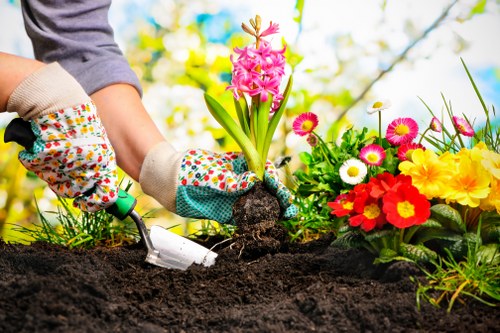 To support broader community engagement we maintain a set of practical, low-impact measures: promoting mulching and sheet composting, offering seasonal community compost giveaways from processed green waste, and creating neighbourhood swap events for surplus pots and tools. These actions extend the reach of our sustainable gardening and eco-friendly waste disposal area strategy by keeping useful materials in circulation and reducing the volume entering municipal systems.
In practice, Gardener Purley’s sustainability commitment is realised through clear metrics and visible outcomes: progress toward our 70% recycling target, reduced transport CO2 from low-carbon vans, active charity partnerships that redistribute materials, and close coordination with local transfer stations and borough separation schemes. By treating green waste as a resource and integrating local recycling practices we make every garden project an opportunity to improve soil health, support community green spaces and reduce environmental impact across Purley.
We continue to evolve: trialling alternative fuel options, piloting on-site composting bays for larger sites, and expanding our network of charities and community hubs. The goal is simple — to turn Gardener Purley into a recognised model for an eco-friendly waste disposal area and a practical, scalable sustainable rubbish gardening area across the borough, with measurable recycling performance, lower emissions and stronger community reuse pathways.